
By Nathanael Winslow, Applications Engineer at AFL
Fiber optics are often associated with high-speed internet and telecommunications. But they also play a foundational role in the modern electric grid. While the internet and electricity may seem like completely separate systems—one transmitting photons, and the other transmitting electrons—today’s grid depends heavily on advanced communications infrastructure to operate safely and efficiently. Fiber optics is an integral part of the modern electric grid. And the internet is highly dependent on the electric grid, too!
Generation, Transmission, Distribution, and Substations
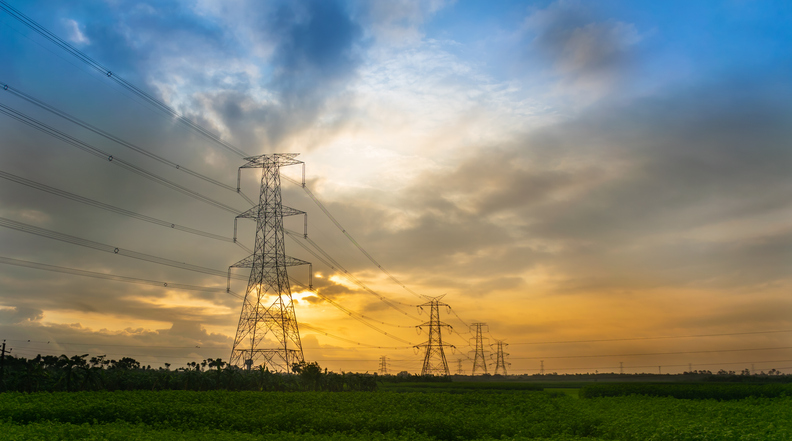
There are three primary steps in the process of supplying electricity to homes and businesses: generation, transmission, and distribution. Generation is the step of the process where electrical energy is generated and introduced into the grid. Transmission lines transmit large amounts of electricity over long distances at high voltage. Distribution lines branch out and distribute the electricity to end users in a relatively local area. Wherever generation, transmission, or distribution meet, you will find substations, which control and regulate electricity, playing a critical role in routing electricity to where demand is highest and in isolating faults to as small an area as possible.
SCADA Systems
Described in terms of its four main building blocks, the grid doesn’t sound too complicated. But the truth is that it is vast and very complex. You can imagine that monitoring, controlling, and coordinating the supply of electricity from tens of thousands of generation sites to hundreds of millions of separate destinations requires a sophisticated system of communications technology, sensors, automation, and remotely controlled devices. The term for this is a SCADA system. It stands for “Supervisory Control and Data Acquisition,” and its function is in its name. It allows electric utilities to acquire data about, supervise, and control the grid, all from a centralized location called the control center.

There are sensors all throughout the grid, monitoring everything from voltage and current to temperature, wind speeds, and vibration. These sensors inform the electric utility about the condition of the grid. The information collected is fed back to the control center, where it is processed and stored by computers or displayed for human operators. The feedback provided by these sensors allows operators to respond very quickly to outages and balance generation with demand in real time.
From the control center, human operators or automated logic controllers can send control signals to remote devices in the field. Many of these devices are in substations. They include circuit breakers and switches, transformers, capacitors, and many others. This allows performance of actions like isolating faults, redirecting power, and regulating voltage levels without leaving their desks.
Field crews also benefit greatly from SCADA systems as they seek to maintain the grid, which requires careful coordination to allocate limited resources across vast areas. SCADA supports this work by detecting problems quickly, pinpointing the physical location of damage, and improving safety for crews in the field by equipping them with real-time knowledge of the grid’s condition. SCADA provides the information field crews need to prioritize and plan work for maximum efficiency and safety.
Private Communications Networks
Closely related to SCADA is the concept of private communications networks. However, while closely linked, it is important to point out the distinction. Put simply, SCADA operates on the private communications network, but so do other services. For example, internal voice communications, IT traffic, and surveillance feeds also utilize the electric utility’s private communications network.
Fiber Optics' Role in SCADA
To be effective, SCADA systems require reliable, secure, and high-speed communications to connect the remote sensors and devices to the control center. In many cases, fiber optics offers a wide range of benefits and fits the bill better than any other communications technology. It offers extremely high bandwidth (even more than required in many cases), scalability, low latency, high security (it can’t be intercepted or tampered with), and long reach. It is relatively unaffected by changes in weather and, in general, has a long life expectancy (25-40 years).

In many cases, it also makes use of existing assets. For these reasons, fiber optics has been adopted as the backbone communications technology for many SCADA systems. In fact, SCADA is the primary use of optical fibers by electric utilities. For security reasons, electric utilities must have private communications networks that are separate from public telecommunications services. To that end, they are often required to dedicate individual fibers or entire cables to internal communications purposes. Other technologies, including microwave, satellite, cellular networks, power line carrier, and copper communications cables, are also used for communications. Each technology has pros and cons, and often multiple technologies are used in the same network, either for redundancy or in different parts of the network.
Conclusion
SCADA serves a critical role in the modern electric grid, and fiber optics play an equally critical role in supporting SCADA and other essential utility communications. As grid modernization continues, the importance of secure, high-performance fiber infrastructure will only continue to grow.
--
About the Author:
Nathanael Winslow is an Applications Engineer in AFL’s Energy group, specializing in fiber optic cable systems for electric utilities. He holds a B.S. in Engineering from Bob Jones University and has six years of professional experience in fiber optic cable design and manufacturing. Every day, Nathanael collaborates with electric utilities across North America to design and select the appropriate fiber optic cable products for their specific applications. Nathanael can be reached at Nathanael.Winslow@AFLglobal.com.